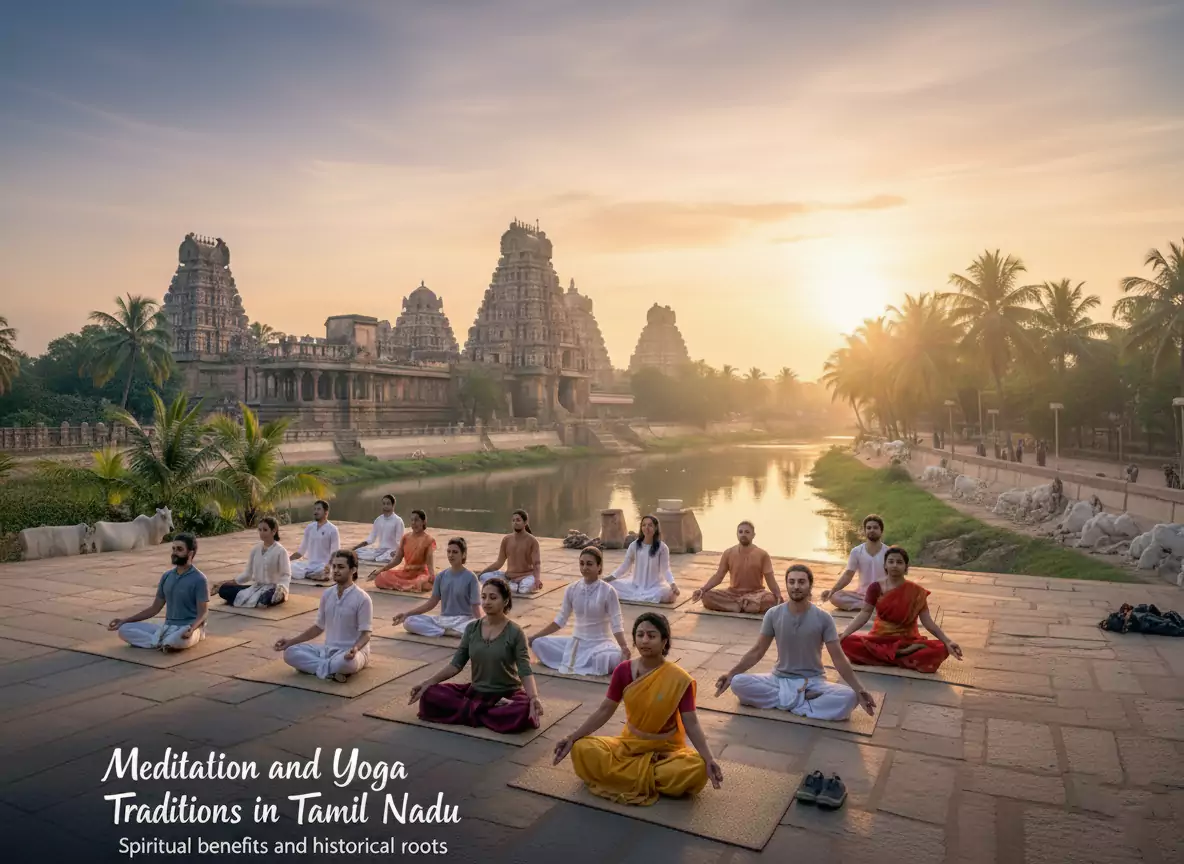
Meditation and Yoga Traditions in Tamil Nadu — Spiritual Benefits and Historical Roots
In the sacred land of Tamil Nadu, where rivers like Kaveri (காவேரி) and Vaigai (வைகை) have nourished civilizations, the traditions of yoga and meditation have flowed silently like underground streams, shaping the lives of saints, seekers, and everyday devotees. Here, meditation is not merely a practice of silence, nor yoga a series of postures, but a spiritual bridge that unites the soul (ஆன்மா) with the eternal cosmic presence. To walk into the temples, forests, and ashrams of this land is to step into a living library of yogic wisdom, echoing with chants, mudras, and timeless silence.
Historical Roots of Yoga in Tamil Nadu
The roots of yoga in Tamil Nadu are as ancient as the Sangam age, when poets sang of sages meditating in forests and mountains. Inscriptions reveal that yogic practices were woven into temple rituals, where saints and siddhars (சித்தர்) sought liberation through discipline and contemplation. The Siddha tradition, unique to Tamil heritage, emphasized meditation, breath control, and inner alchemy. Masters like Agastya — revered as the father of Tamil Siddha medicine — combined spiritual insight with yogic science, teaching that the body is a vessel for divine realization. The chants of the Alvars and Nayanmars, though devotional in tone, are rooted in meditative surrender, reflecting the philosophy that yoga is not separation from life, but immersion into its sacred essence.
Temples as Seats of Meditation
Unlike modern yoga halls, the temples of Tamil Nadu were the earliest centers of yogic practice. The stillness of the sanctum (garbhagriha – கர்ப்பகிரகம்), the rhythm of the temple bells, the fragrance of camphor and tulsi (துளசி), all created an environment of natural meditation. In places like Chidambaram Nataraja Temple, where Lord Shiva is worshipped as the cosmic dancer, meditation transcends posture and becomes a vision of rhythm and silence. In Thiruvannamalai, the holy hill Arunachala itself is considered a form of Shiva, where Ramana Maharshi sat in profound meditation, guiding seekers into the practice of self-inquiry (atma vichara – ஆத்ம விசாரம்). Here, meditation is not learned but awakened, as the hill whispers the truth of stillness.
The Spiritual Benefits of Meditation and Yoga
The yogic traditions of Tamil Nadu see meditation not merely as a way to calm the mind, but as a doorway to liberation (moksha – மோக்ஷம்). Breath (prana – பிராணன்) is regarded as the sacred link between the body and the cosmos. When harmonized through yogic techniques like pranayama, it purifies the senses, stabilizes the mind, and awakens inner clarity. Meditation, in its essence, is seen as the art of stilling the waves of thought, allowing the soul to reflect its true divine nature. Practitioners discover not only peace but also physical vitality, emotional balance, and spiritual strength. For the Tamil Siddhars, yoga was a means to extend life, refine the body, and transform it into a luminous instrument of divine will.
Cultural Resonance
Meditation and yoga in Tamil Nadu have never been isolated practices but are deeply interwoven with cultural life. During temple festivals, as the deities are carried in chariots with music, dance, and chants, one perceives the yogic truth of union — between sound and silence, movement and stillness. Bharatanatyam (பரதநாட்டியம்), the classical dance of Tamil Nadu, is itself a form of yoga, where every mudra (gesture) and abhinaya (expression) becomes a spiritual meditation. The songs of Thevaram and Divya Prabandham carry rhythms that align the breath of the devotee with the divine heartbeat. Even the cuisine of Tamil Nadu, rooted in sattvic (pure) principles, reflects yogic wisdom, teaching balance and harmony in daily life.
Reflections Across Time
What makes Tamil Nadu’s meditation and yoga traditions unique is their continuity. From the Siddhar caves of Palani to the ashrams of Coimbatore, from the echoing chants of Rameswaram to the silent halls of Kanchipuram, the same river of practice flows — uninterrupted, timeless. These traditions remind us that yoga is not just an exercise of body, nor meditation just an escape from life. They are pathways to see the sacred in the ordinary — the divine hidden in breath, the eternal shining through silence.
A Timeless Benediction
Meditation and yoga in Tamil Nadu are not ancient relics, but living flames passed from guru to disciple, saint to seeker, heart to heart. They invite us to pause, to breathe, to turn inward — not as an act of withdrawal, but as a celebration of existence. To sit in silence beneath a temple gopuram, or by the flowing banks of the Kaveri, is to touch the pulse of eternity itself.
“In the hush of breath, in the rhythm of silence,
I meet the eternal —
where the body is temple,
the breath is mantra,
and the soul is free as the sky.”