
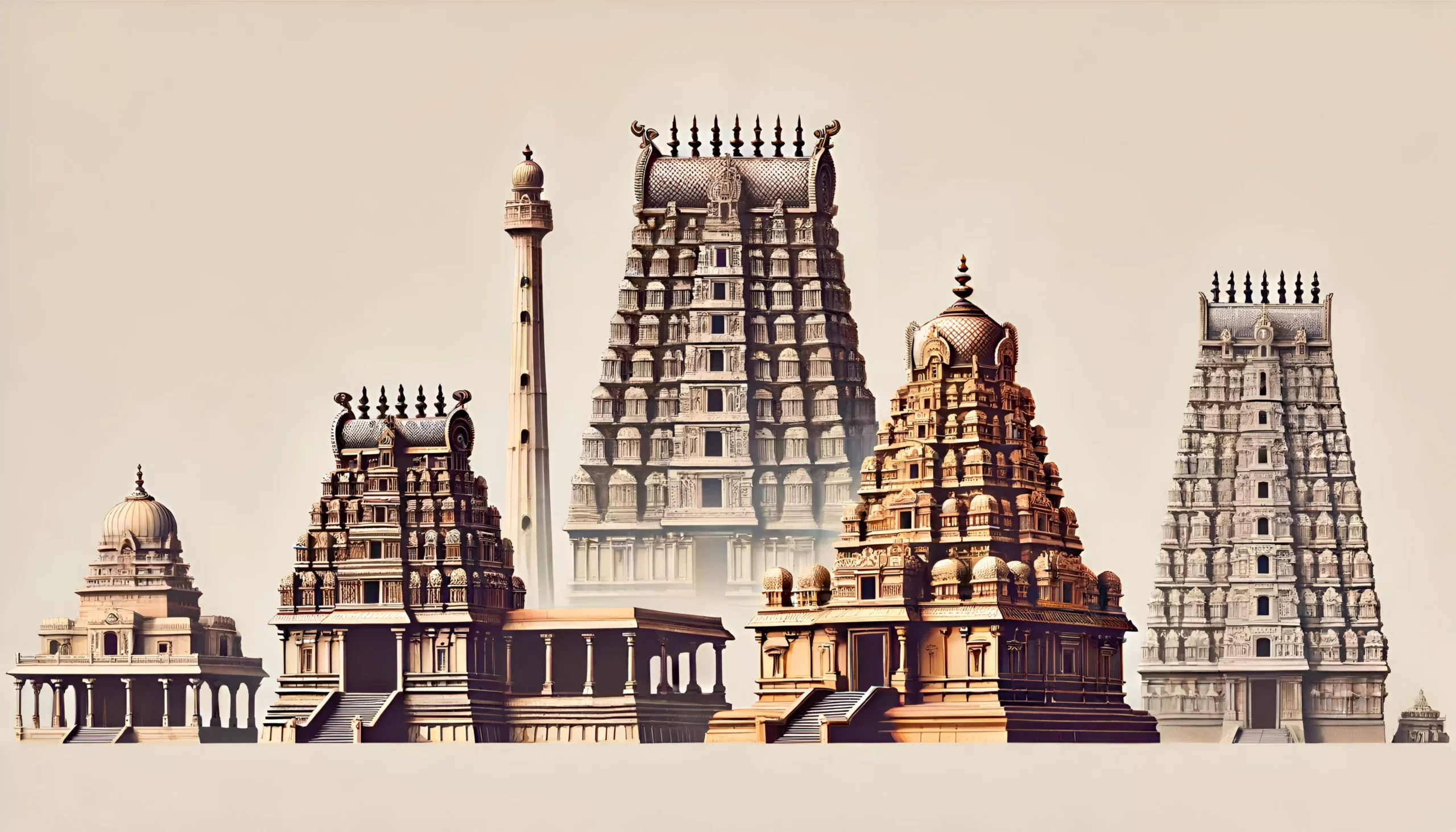
The core structure of every temple in Tamil Nadu reveals a sacred blueprint, carefully designed to mirror the connection between human life and the cosmos. As you step into a temple, the Gopura, the towering entrance gateway, rises above you, guiding your eyes toward the heavens and symbolizing the passage from the worldly to the divine.
Crossing its threshold, you enter the Mandapa, the grand hall where devotees gather, chant, and share in community worship—a place that resonates with the collective energy of faith. Moving inward, you reach the Garbhagriha, the sanctum sanctorum, a small yet powerful chamber where the deity resides and divine presence radiates boundless energy, inviting every seeker into stillness and surrender.
Above this sacred space stands the Vimana, a symbolic link between the earthly realm and the divine, reminding us that human life is inseparably connected with higher consciousness. Crowning the temple is the Shikhara, the spire that soars upward like a cosmic mountain, representing the axis of the universe itself.
Every step inward is a step closer to the self—each layer of the temple drawing you from the noise of the outside world into the quiet truth of the soul.
Built in harmony with Vastu Shastra and Agama Shastra, and brought to life through rituals of Prana Pratishtha with copper, gold, and mantras, these temples are not just monuments—they are channels of Prana, the universal cosmic energy itself.
Over time, When visiting temples, rituals help deepen the spiritual experience and create a sense of connection with the divine — they are experiences. They bring peace, clarity, and connection.
They recharge the body, calm the mind, and lift the spirit.
This realization gave birth to Be Spiritual.
Our mission is simple: to help others experience the same transformative journeys that shaped my life.
Through pilgrimages, cultural immersions, wellness retreats, astrology-based explorations, and customized spiritual tours, we create opportunities for seekers from around the world to reconnect—with themselves, with nature, with culture, and with the divine.
Every journey we curate is carefully crafted: from planning itineraries and arranging temple rituals to offering meditation, yoga, Ayurveda, and cultural workshops.
Each experience is designed not just as a trip, but as a path of inner awakening.
At Be Spiritual, we believe that travel is more than just movement—it is a transformative experience.
And every journey with us is an invitation to unleash your inner light.
D Dravidian architecture is unique in its design and purpose, guiding spiritual seekers toward higher states of consciousness. A temple is not merely a place of worship—it is a sacred space where architecture, symbolism, and energy converge to elevate the devotee’s mind, body, and soul.
The journey begins at the gopura, the towering gateway that marks the entrance to the temple complex. Crossing through it is more than a physical act; it is an initiation into the temple’s sacred energy. Devotees often experience a sense of cleansing as they step inside, leaving behind worldly distractions and entering a realm of spiritual vibration.
A defining feature of Dravidian temples is the prakara or prakaram—enclosing walls that surround the central shrine. These concentric, rectangular courtyards separate the sacred from the secular. Each successive enclosure symbolizes a transition, drawing the devotee closer to the divine center. Larger temples may have multiple prakaras, with towering gopurams punctuating their entrances, creating a vast sacred complex.
Thus, the prakaras represent stages of inner purification—each step inward is a step deeper into the spiritual journey.
Beyond the enclosures lies the mandapam, a pillared hall where devotees gather for worship, rituals, and chanting. The mandapam serves as a preparatory space, calming the mind and aligning the devotee’s energy before approaching the sanctum. Its architecture encourages contemplation and unity, harmonizing body, mind, and spirit for the sacred encounter ahead.
At the heart of the temple lies the garbha-griha, or “womb-chamber.” This small, dimly lit chamber symbolizes the womb of the universe, the source of all creation. It houses the main deity, the ultimate focus of devotion and energy. Access is often limited to priests, but for devotees, even glimpsing the deity from outside the sanctum is considered a profound spiritual blessing.
The garbha-griha is not just a chamber—it is the spiritual nucleus where cosmic energy is concentrated.
Above the sanctum rises the vimana, a pyramidal, multi-tiered tower. It is the most sacred structure after the sanctum itself, channeling divine energy from the garbha-griha upward. The vimana is adorned with sculptural depictions of gods, celestial beings, and mythological stories. In early masterpieces like the Brihadeeswarar Temple of Thanjavur, the vimana was the tallest and most dominant feature, symbolizing the axis between heaven and earth.